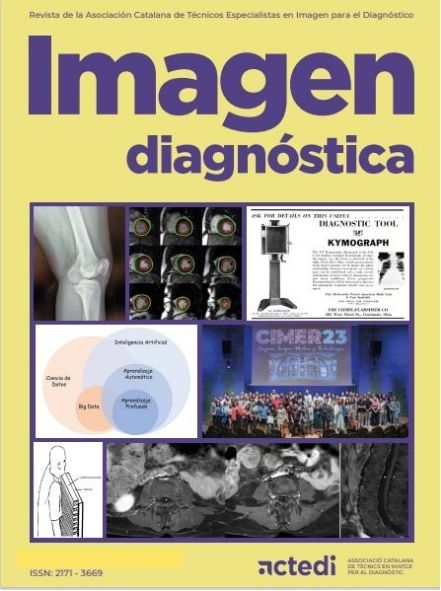
Imagen Diagnóstica is committed to maintaining the highest standards of research integrity, transparency, and professional responsibility in diagnostic imaging and imaging technology. This policy applies to authors, reviewers, editors, and anyone involved in the publication process. The journal uses a single-blind peer review model and publishes under diamond open access with CC BY 4.0 licensing.
1. Core principles
The journal expects all parties to uphold:
Integrity and honesty in the conduct and reporting of research and professional work
Transparency in methods, data, funding, and conflicts of interest
Respect for patients and participants, including privacy and informed consent
Fair, independent editorial decisions based on scholarly merit
Confidentiality in peer review and editorial handling
Corrections to the scholarly record when errors or misconduct are identified
2. Author responsibilities
Originality and prior publication
Authors must submit original work that has not been published previously and is not under consideration elsewhere. Any overlap with prior publications (including conference abstracts, preprints, theses, or translated versions) must be clearly disclosed at submission. Text recycling and redundant publication are not acceptable without transparent citation and justification.
Accurate reporting and reproducibility
Authors must present results honestly and accurately. Methods should be described in sufficient detail to allow understanding and, where appropriate, replication. Any limitations, assumptions, and sources of uncertainty should be disclosed.
Data availability and transparency
Where applicable, authors should describe data sources, inclusion/exclusion criteria, and statistical methods clearly. If data or code cannot be shared (e.g., privacy restrictions), authors should explain the reason and provide an appropriate data availability statement.
Authorship and contributorship
Authorship must reflect substantial intellectual contributions. All listed authors must:
have contributed meaningfully to the work,
approve the final version, and
agree to be accountable for the content.
Changes to authorship after submission (adding, removing, or re-ordering authors) require a written explanation and confirmation from all authors.
Conflicts of interest
All authors must declare any financial or non-financial conflicts of interest that could influence interpretation (e.g., employment, consultancies, honoraria, equipment support, patents, personal relationships). If none exist, authors should state: The authors declare no conflicts of interest.
Funding disclosure
Authors must disclose all funding sources and the role of funders (if any) in study design, data collection, analysis, manuscript preparation, and publication decisions. If there was no funding, state: This work received no specific funding.
Ethical approvals (human participants and clinical material)
For research involving humans, authors must state whether ethics approval was obtained and provide the name of the approving body (and approval number if available). If approval was not required, authors must explain why.
Patient privacy and consent for images
Diagnostic imaging often involves sensitive clinical information. Authors must protect confidentiality by removing identifiers and avoiding unnecessary personal details. For case reports and any clinical images where a patient could be identifiable, authors must confirm written informed consent for publication from the patient or legal guardian. Authors are responsible for ensuring that consent documentation exists and can be provided to the journal upon request.
Image integrity and permissible adjustments
Images must represent the original data faithfully. Unacceptable practices include selective enhancement, removal, or obscuring of features that could mislead readers. Permissible adjustments (e.g., brightness/contrast) must be applied to the entire image and must not alter interpretation. If composite images are used, authors must clearly describe how they were assembled.
Use of AI tools
If authors use AI-assisted tools for writing, translation, image processing, or data analysis, this must be disclosed in the manuscript. Authors remain fully responsible for accuracy, originality, proper citation, and compliance with patient privacy. AI tools cannot be listed as authors.
3. Reviewer responsibilities
Confidentiality
Manuscripts sent for review are confidential. Reviewers must not share, distribute, or use manuscript content for personal advantage.
Objectivity and constructive feedback
Reviews should be professional, fair, and evidence-based. Reviewers should identify strengths, weaknesses, missing citations, methodological limitations, and areas needing clarification.
Conflicts of interest
Reviewers must declare conflicts of interest and decline review if impartiality may be compromised.
Timeliness
Reviewers should accept reviews only when they can complete them within the requested timeframe. If delays occur, reviewers should inform the editorial office promptly.
4. Editor responsibilities
Editorial independence and fairness
Editorial decisions are based solely on scholarly merit, relevance to scope, clarity, methodological soundness, and ethical compliance. Decisions are not influenced by commercial considerations, sponsors, or third parties. The journal maintains editorial independence at all stages of review and publication.
Confidentiality
Editors and staff must protect the confidentiality of submissions and peer review records.
Conflict of interest management
Editors will recuse themselves from handling manuscripts where a conflict exists (e.g., personal, institutional, or collaborative relationships). Another qualified editor will be assigned.
Transparent decision-making
Editors aim to provide clear reasons for decisions and to ensure that reviewer comments are communicated respectfully.
5. Misconduct and unethical conduct
The journal takes allegations of misconduct seriously, including:
plagiarism and self-plagiarism
duplicate submission or redundant publication
data fabrication or falsification
inappropriate image manipulation
undisclosed conflicts of interest or funding
manipulated or compromised peer review
unethical research practices or missing consent/approval
Investigation process
When concerns arise, the journal may:
conduct an initial assessment,
request explanations and supporting documentation from authors,
consult reviewers or independent experts when necessary, and
contact institutions or ethics committees in serious cases.
Outcomes
Depending on findings, actions may include:
rejection of the manuscript,
request for correction or clarification,
publication of a correction,
expression of concern,
retraction, and/or
restriction of future submissions for a defined period.
6. Corrections, retractions, and updates to the record
If a published article contains significant errors, the journal will take appropriate action to maintain the integrity of the scholarly record:
Correction (erratum/corrigendum) for honest errors that affect understanding
Expression of concern when an investigation is ongoing but unresolved
Retraction when findings are unreliable due to misconduct or major error, or when ethical breaches occur
Retractions and corrections will be clearly linked to the original article.
7. Authorship disputes and complaints
Disputes about authorship, contributorship, or ethical concerns may pause review or publication until resolved. The journal may require written statements from all authors and, where appropriate, confirmation from institutions. Complaints about editorial handling are reviewed by the Editor-in-Chief (or an independent editor when needed).
8. Third-party copyright and permissions
Authors must obtain permission for any third-party copyrighted material (figures, tables, images) used in their manuscript, unless it is clearly licensed for reuse. Proper credit must be provided.
9. Advertising and commercial influence (if applicable)
If the journal displays advertisements or receives operational support, such activities do not influence editorial decisions. Editorial content and peer review remain independent.
10. Contact for ethics concerns
Concerns about research integrity, peer review, or publication ethics should be reported to: editor@imagendiagnostica.org